
The Gaza Strip
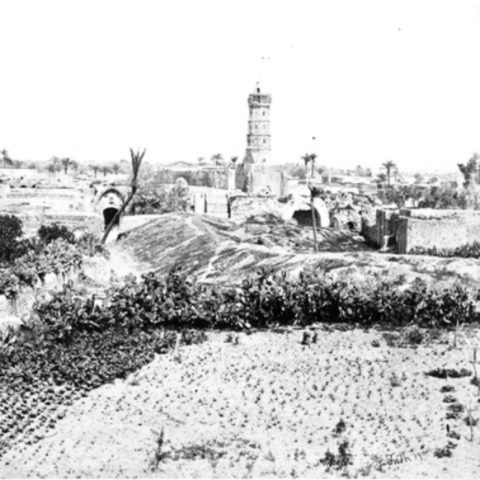
Gaza has been an important trade hub for roughly 5,000 years but everything in Gaza was dramatically changed following the declaration of the state of Israel in 1948.
The aftermath of the Arab-Israeli war
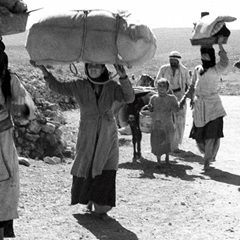
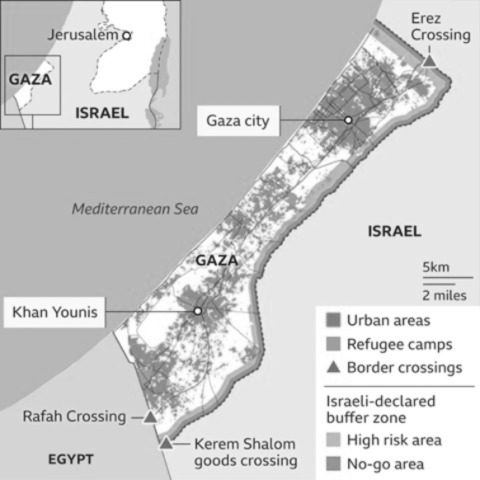
The Arab-Israeli war of 1947/1948 left approximately 750,00 Palestinian refugees, forced to flee or expelled from their homes. Roughly 200,00 of these refugees fled into a narrow strip of land around Gaza. This resulted in the tripling of the population of the region. Egypt assumed control of the region but it was not considered part of Egypt and its inhabitants were not regarded as Egyptian citizens. The majority of the refugees were accommodated within eight refugee camps that were established in 1948 and 1949 by the American Friends Service Committee (AFSC), a Quaker organisation. The camps were initially set up using canvas tents.
The United Nations Relief and Works Agency for Palestine Refugees in the Near East (UNRWA) was set up following the Arab-Israeli war to provide relief for Palestinian refugees. In May 1950 UNRWA took responsibility for the running of the camps from the Quakers. Following a harsh winter in 1950 which lead to the collapse of the canvas tents, UNRWA replaced these with 150 square-metre cinder block shelters with zinc or iron roofs. By this time it was apparent that the displacement of Palestinian refugees was not going to be resolved any time soon.
Apart from the influx of tens of thousands of refugees, Gaza had also been cut off from its traditional trade routes. This, combined with the increase in population, meant that Gaza was dependent on food relief being provided by UNRWA. People, who had once been able to farm their own lands to provide for their families, were left having to join lines and show ration cards in order to be given handouts. Under Egyptian administration there were restrictions on movement and for the majority of the population they were unable to move beyond the narrow confines of the Gaza strip.
Beginning of Israeli military occupation
Following the six day war that took place between Israel and a number of its Arab neighbours in 1967, the Gaza strip was captured by Israel. Under military occupation there were strict security controls and Jewish settlements were created within the Gaza strip, leading to the displacement of more Palestinians. Further displacements occurred during a brutal crackdown on any form of dissent in 1970/1971 with roads through refugee camps being widened to allow tanks to move more easily within the refugee camps. The Gaza economy also became dependent on Israel with many Palestinians commuting daily into Israel for low wage labour.
In 1987 the first Palestinian uprising, or intifada, began. Simmering tensions regarding the Israeli military occupation, the loss of land and expanding Jewish settlements produced widespread civil disobedience throughout both the Gaza strip and the West Bank. Under the Oslo Accords of 1993, Israel transferred limited internal administrative control of Gaza to the newly formed Palestinian Authority (PA), led by Yasser Arafat. However, Israel retained control over Gaza's borders, airspace, and the Jewish settlements. This agreement created the Palestinian Authority and gave Palestinians limited self-rule in parts of the West Bank and Gaza.
A second intifada began in 2000 and would continue until 2005. It was marked by violent clashes between the Palestinians and Israeli military forces. Palestinians attacked Israeli civilian targets through suicide bombings whilst the Israeli military launched large scale military incursions and targeted assassinations. The uprising gradually subsided and drew to an official close following the Sharm el-Sheikh Summit in February 2005, where Palestinian President Mahmoud Abbas and Israeli Prime Minister Ariel Sharon committed to halting all acts of violence. Perhaps more significantly, public disillusionment with the corruption of the ruling Fatah party during this era paved the way for Hamas to win the Palestinian legislative elections in 2006.
The impact of the victory of Hamas
Hamas refused to recognise the existence of the state of Israel and called openly for its destruction. They also refused to enter into any sort of negotiations with Israel in order to achieve some sort of peaceful settlement between the two opposing sides. This created a difficult situation for the international community following the electoral triumph of Hamas in the elections. Hamas was widely regarded as a terrorist organisation. Analysis of the election suggested that many Palestinians had voted for Hamas because of their disillusion with Fatah who had previously been in power rather than their support for what Hamas was about.
In 2007 a factional war broke out between Fatah and Hamas which ultimately resulted in Hamas taking full control of Gaza. With Hamas in control both Egypt and Israel launched a blockade of the Gaza strip. The following years saw continuous blockades and repeated military conflicts between militant groups in Gaza and the Israeli military. Human rights organisations and the United Nations frequently condemned the blockade as a form of collective punishment. It severely restricted the movement of people, medical supplies, fuel, electricity, and construction materials, earning Gaza the colloquial title of the "world's largest open-air prison".
The attempt by Israel to demonise Hamas and to use its election victory as an excuse for blockading Gaza is complicated by its history of supporting Hamas in the past in order to prevent momentum toward a unified Palestinian state. For over a decade leading up to 2023, Israel allowed millions of dollars in Qatari funding to be transferred into the Gaza Strip—often delivered in cash—to pay for public salaries and fuel, viewing a financially afloat Hamas as a manageable governing authority rather than seeking its total collapse. Israeli policy treated Hamas as a containment challenge through periodic military operations ("mowing the lawn") while maintaining a strict blockade. But its longer term objective has always been to seek to divide the Palestinians in order to ensure that a viable Palestinian state is never allowed to be formed.